Though the majority of my posts have focused on social and political issues, gaming has always been at the heart of BMD. It's always been one of my favorite pass-times at least. To introduce that portion of BMD, I have a showcase of videos from the YouTube channel PrinceJamal89. I'm also streaming on Twitch under the same name. The clips, videos, and commentary are rough now, but as I continue to improve and expand you'll get a front row seat to watch the channel mature.
First up is Heroes & Generals:
This was also my first attempt at streaming PC games. For those not familiar with the game, Heroes & Generals is a FPS set in WW2. The players can take on the ranks of 3 different militaries(US, Germany, Russia). You start out as a private soldier, but as you gain experience and money you can join other branches and use equipment like tanks, planes, and other vehicles. The highest rank is General for all teams. Once you reach that rank, you have access to the strategy platform for the game. As a General you manage resources, soldiers, and choose which cities to attack which sets the pace for the experience rank and file soldiers have on the FPS platform.
Next up is Deadliest Warrior:
This is one of my favorites since it has historic figures like Shaka Zulu and Hannibal. The game features figures covered in the show. In this clip, I was showing off the game's conquest mode. The game puts two legends on opposite ends of a map and both legends battle for control of the map.
The last game for this post - Fallout 4:
Fallout follows the player you survive the wilderness of what used to be the US 200+ years after nuclear fallout wiped out the modern world. The FPS/RPG combined with commerce and deep storylines, all in an open world got me from the first time I picked up Fallout New Vegas.
In this clip I show off the damage and fortification of one of my settlements following an attack.
Saturday, August 13, 2016

Bullshit Busting: Dealing with Actual Facts
To start the bullshit busting section of "The System" where we will be reviewing memes, news, urban legends, rumors, and conspiracies to separate the facts from the fiction. We'll start by looking at some ways to do the knowledge to see how information and misinformation can help and hurt people looking to make a difference in their communities. First up is a tool kit organized by Carl Sagan he called the "Baloney Detection Kit". I'm summarizing the points here, but you can check out the links to find the full text(That's your first test).
Carl Sagan's Bullshit Detection Kit
1) Fact check(and double-check) the facts and evidence
2) Check the facts from different points of view
3) No expert or authority is too good to be questioned
4) Every story has more than one side. Look at all of them.
5) Check all the ways your point of view could be wrong. If you don't, somebody else will - and don't get in your feelings when that happens.
6) Numbers and video don't lie, not always. Use them.
7) Weak points weaken arguments(go back to #5)
8) Occam's Razor: The argument with less holes is best
9) Claims that can't be tested are worthless
With these tools we can take on whatever information we want and discern between fact, fiction, hoaxes, satire and handle it that way.
Carl Sagan's Bullshit Detection Kit
1) Fact check(and double-check) the facts and evidence
2) Check the facts from different points of view
3) No expert or authority is too good to be questioned
4) Every story has more than one side. Look at all of them.
5) Check all the ways your point of view could be wrong. If you don't, somebody else will - and don't get in your feelings when that happens.
6) Numbers and video don't lie, not always. Use them.
7) Weak points weaken arguments(go back to #5)
8) Occam's Razor: The argument with less holes is best
9) Claims that can't be tested are worthless
With these tools we can take on whatever information we want and discern between fact, fiction, hoaxes, satire and handle it that way.
Sunday, January 3, 2016
The System and Black Thought: Bridging the Gaps
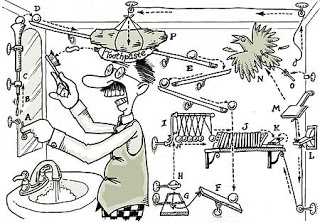
Rube Goldberg Machine
The "system" that we live in as a people here in America, how it works, who the system was designed by and who it was designed for, who controls it, what needs to be done about it, and why, are usual points of debate. And there are about 64655465861567 different answers to those questions for every person that cares to put their two cents in. So as an introduction to the Political Education and Conspiracy Theory series that are coming up here at BMD, I'll put my two cents in and point out some of the bullshit that people add to black political thought, by accident or on purpose.
1) Giving white people so much credit
As a computer scientist by trade and an independent student of politics, history, and philosophy, all of these fields basically built themselves around the study of systems and critical thinking. The basic way a system works is it takes input, does something with that input, and puts out a result, based on how the system was designed. Whether that system works for you or not depends on what you put into it and how you use what it returns, the same with life in general. If you let some people who claim to be "pro-black" tell the story of "the System" they make the "white man" out to look like an unstoppable force driven to destroy the world, and we're waiting on that unstoppable (enter figure, event, or group of people here) to wake up and stop it - like something out of a comic book. It may SOUND pro-black, but it really gives white people credit where no credit is due. Quit while you're ahead(or behind) because that way of thinking hasn't worked, and it's probably not going to. If a system exists, it can be studied, controlled, changed, or taken apart. Black power is about controlling any system that affects the lives of black people and making it work for us.
2) Black Nationalism and its role in the system
When you hear the term "pro-black" the meaning changes depending on who it is that's speaking. If you study the movements of Black people in America, you'll find that "Pro-Black" is a pretty broad name for a number of different philosophies, like the Liberal/Moderate/Conservative polarities in mainstream politics. On one end you have Black Nationalism and Black separatism on the other. They all have similar goals, but different views on how those goals should be reached, and who can(and can't) put in the work to make it happen. Instead of recognizing how deep the movement really is, people get fanatic to the point that anyone who disagrees with them is "part of the problem''. Black Nationalism can be broken down into subsets focusing on culture, politics, economics, etc. There are groups that focus on these specific fields, and others that address all of these fields at the same time. At the end of the day, Black Nationalism advocates the advancement of Black People and pursuing those opportunities however and whenever they are available. Advancing in any of these fields, both on the individual, and collective levels, is a step in the right direction towards power and self-determination.
3) By (almost) any means necessary
The above quote by Malcolm X is probably one of the most popular and mis-represented quotes of this century. The full quote, which many people like to leave out is ''We declare our right on this earth to be a man, to be a human being, to be respected as a human being, to be given the rights of a human being in this society, on this Earth, in this day, which we intend to bring into existence by any means necessary." Taken on face value, it literally means to do whatever is necessary to make sure that Black people overcome oppression to become self-sufficient and respected as a people. But going back to point #2, that list of "anything" eventually gets cut to a predefined set of options that look and sound “pro-black”.This series is designed to bridge those gaps that prevent us from making progress as a people, pointing out the advantages and disadvantages of the parts of the machine that we live in, and airing out the bullshit that ends up getting in our way.
Friday, July 3, 2015
TPP: Opportunity and Power

Knowledge is to supply yourself with facts. By adding on to those facts, you put yourself in a position of power and the ability or authority to bring about justice(knowledge add a cipher). In light of the news about the Trans Pacific Partnership (TPP). I've seen a lot of people trying to fight it because of the cons associated with it, but there are many pros that the common man can take advantage of. Even with the current economic structure(s) there's opportunities available, especially for the Original Man can take advantage of.
Doing the knowledge to the current global economic systems gives us equal opportunity to add on to our own power and stability, with the ability to represent and expand our culture to the national and global economic, political, and social arenas.
For example, above is a shareholder voting form that I get every year from a major oil corporation I invested in. For the price of a pair of Jordans, I have the power to vote on decisions the company makes(ex. Forcing the company to publish its political activity, forcing the company to hire someone to monitor its impact on the environment, etc). And these changes were all proposed by other shareholders, Tyrone from up the block. So imagine if a group of people put their Jordan money together to get the power to vote as a group on these same issues. The company can be as good or as bad as it wants in the political, economic, and moral areas, but at the end of the day it has to answer to the shareholders knowing if it pisses us off too much, board members can lose their spot on the board, and we can take our money somewhere else. And on top of that, the company PAYS ME 4 times a year just because I put money on their books ONE time. I can pass that down to my seed, and if he's smart, he'll keep it, and be able to pass it down to his seeds or soil. And if we hard up for money, we can sell the stock and keep the cash.
You can make up all the conspiracies you want, and rant and rave about major corporations all you want, but true or not, they have no reason to listen to you or anyone else complaining about their operation if you're not a stakeholder in their operations - an owner, supplier, or customer. Stakeholders and the government are the two major groups that corporations, or businesses in general answer to. They set the rules that the business must follow (or work around) and use their money, or the law, to make that happen.
On the other side of the TPP, with Asian companies manipulating their currency exchange rate, the common man could, for example, buy a stack of ps4s or generic computers or tablets or whatever for a discounted rate, straight from the factory, and then flip them in his own community. The TPP got its pros and cons, but there's always been ways for the common man to take advantage right along with the big dogs.
Overall, regardless of the rules, regulations, or trade agreements that currently exist, or that will exist in the future, it's up to us as a community, and each individual to decide if they will be a victim of the changing times, a victor of the changing times, or a catalyst for new changes.
Thursday, July 2, 2015
It Ain't Rap's Fault
"Hip Hop is the CNN of the Black Community"
Since Hip Hop's emergence into the public eye, it has constantly come under scrutiny All this hating Rap music gets old... Your uncle, brother, cousin, step-dad, friend is more likely to influence you to become an alcoholic or drug addict than a rapper. Only those people can give you PHYSICAL ACCESS to those things. The music can influence your way of thinking, yes. But if those lifestyles are already in your environment then you can't blame music. What about the white people who listen to Taylor Swift and still do drugs?
Music simply imitates whats already in society. Actually, drugs and music have gone hand in hand as long as humans have been around. Nobody's calling Jimi Hendrix or Bob Marley enemies of the community.
Since Hip Hop's emergence into the public eye, it has constantly come under scrutiny All this hating Rap music gets old... Your uncle, brother, cousin, step-dad, friend is more likely to influence you to become an alcoholic or drug addict than a rapper. Only those people can give you PHYSICAL ACCESS to those things. The music can influence your way of thinking, yes. But if those lifestyles are already in your environment then you can't blame music. What about the white people who listen to Taylor Swift and still do drugs?
Music simply imitates whats already in society. Actually, drugs and music have gone hand in hand as long as humans have been around. Nobody's calling Jimi Hendrix or Bob Marley enemies of the community.
Wednesday, May 7, 2014
Money on the Net: A Revisit
"Wealth
is a persons ability to survive so many number of days forward - or, if
I stopped working today, how long could I survive?"
- R. Buckminster Fuller
- R. Buckminster Fuller
One night I was glued to the computer with a few drinks and cigarettes, a
calculator, and 10 or more internet tabs open with everything from online gigs for pocket change, investopedia and marketwatch for investment
knowledge, my bank account for moving cash, and my girlfriend
screaming for me to go to bed... No matter how much sleep I may lose on those binges, preparing for the day I leave my
job(whether fired, laid off, quitting, retirement, or death) is what
makes each start of the work week, and work day more bearable....
This independent study has turned into a weekly, if not almost daily habit. This month I decided to give up smoking and drinking to see how much money I could save and invest in other areas. I was recently studying the book Rich Dad Poor Dad by Robert T. Kiyosaki and although I have already been implementing a few of the asset-building activities the author mentions, I welcomed the new perspective on financial literacy concepts. One of the most important is the distinction between an asset and a liability.
Asset = money made whether I work or not
Liability = money spent whether I work or not
So with this new knowledge, we will add on a previous post discussing the opportunities for making money online. Except for number 1, the methods in this list will deal with the idea of generating "passive income" through assets.
1. MTurk
Mturk.com is a website powered by Amazon where workers can search for Human Intelligence Tasks("hits") which are posted by other users. The tasks can be as easy as copying text from a business card and taking surveys, to more advanced hits such as transcribing video and audio recordings. The payment for hits can range depending on how complex or time consuming the HIT is. The hard part is reviewing the gigs that make the most sense to perform, and match your working style and interests. You won't get rich, or even replace your current paycheck, but you can make some extra pocket change.
2. Stocks
When you buy stocks, you own a piece of that company. To raise money, companies will often sell partial ownership of the company as a stock in exchange for money. The company uses this money to grow its current business, or fund new ideas and opportunities.
When dealing with the stock market there are a number of ways to make money. The 2 main methods are sales profits and dividends. How you invest depends on your style and financial goals.
Dividends = Money the company pays you for owning the stock.
Dividends are for long term income and saving money for retirement, children's college funds, and other long term events. Dividends are paid out over time - usually every quarter(3 months). Regardless of what the stock's price is, as long as the company is in business, you get paid.
Gains = Money you make after selling the stock for a profit.
Trading stocks for gains you get the money as soon as the deal is made. You can either reinvest the money on a different stock, or you can keep the cash. There is also more risk here because the value of the stock can cause you to lose money just as easy as it can make money.
When dealing with the stock market there are a number of ways to make money. The 2 main methods are sales profits and dividends. How you invest depends on your style and financial goals.
Dividends = Money the company pays you for owning the stock.
Dividends are for long term income and saving money for retirement, children's college funds, and other long term events. Dividends are paid out over time - usually every quarter(3 months). Regardless of what the stock's price is, as long as the company is in business, you get paid.
Gains = Money you make after selling the stock for a profit.
Trading stocks for gains you get the money as soon as the deal is made. You can either reinvest the money on a different stock, or you can keep the cash. There is also more risk here because the value of the stock can cause you to lose money just as easy as it can make money.
3. CD's and Bonds
Certificates of Deposit(CD's) and Bonds are both like a friend giving you an "IOU", but you invest in them for different reason. A CD is bought through your bank, it's another way of saving your money. The bank holds your CD for anywhere from 3 mo to 5 years, depending on how long you agreed they could hold it. When the time is up, the bank pays you interest on the money you let them borrow. This is giving the bank a short term loan.
Bonds are similar to CDs and work pretty much the same way. The difference is bonds can be bought through a company or a bank. It is a long term loan, usually for 10 years or more. But bonds also normally have a higher interest rate, so more money is made when the bank or company pays you back.
4. Mutual Funds
Mutual Funds combine stocks, bonds, and CDs with other form of investment into one package. The money for these investments comes from groups of investors pooling their money together. Mutual funds are managed by a broker, who handles what to invest the money in, how long, and when. As an investor you buy a share(or part) of the mutual fund. Whenever the fund makes money, through dividends, gains, or interest, that money is paid out to the owners of the fund in dividends. As the value of the funds investments grow, the price of shares for that fund grows too. You can also sell your shares in that fund for cash.
If you don't feel comfortable researching individual companies, or watching the market for the best deals on stocks, bonds, and CDs, a mutual fund is a convenient investment opportunity. But they are also riskier. Just because you have a broker handling the funds for you, doesn't mean they can't make mistakes.
For those who have experience in the investment field, it works like a game to them - no different than going to the casino. The same way you can hit it big and make a lot of money, you can lose it just as fast. It doesn't take a lot of money to get started, all you need is a bank account. I had only $50 in my account when I bought my first stock. By doing your research and taking educated risks, you can make investments work for you, and make money, while managing it all from your computer.
Sunday, June 30, 2013
Post Racial America and Indirect Racism

Since the end of the Civil Rights and Black Power movement, many white people have tried to distance themselves from being labeled a "racist". Although there are many other methods, the internet has long served as a safe medium for many people to voice their true feelings of other races in this current era called "Post-Racial America". With the beginning of George Zimmerman's murder trial, the judicial diarrhea of the US Supreme Court on the Voting Rights Act of 1964, and Paula Deen's (past) diarrhea of the mouth, the events of this week have removed multiple layers from the "Race Relations" onion of American society.
There are 2 types of racism, both of which are common in the US, as defined by Kwame Ture (Stokely Carmichael) in his book Black Power : The Politics of Liberation
 (1967): Individual Racism and Institutional Racism.
Individual racism is a small scale event between individuals or a small group of people in which one group acts against another based on an ideal that is intentionally or neglectfully racist. Paula Deen's "n-word" jokes are little more than examples of individual racism. Which, for those who didn't know, the law suit against Paula Deen was filed by a white employee, and it is about more than simple "n-word" jokes as described in this article from Black Legal Issues. Another example would be a group of Black guys beating up a white guy, just because he's white. As offensive as it may be, incidents involving individual racism do not have a lasting impact on the target group as a whole. But since it is on a person to person basis, the impact may last for the individuals involved. This factor is what allows racist ideals to be passed from generation to generation.
Institutional racism is far reaching in the number of people it affects and is usually carried out by a group of people, although individuals can carry out this form of racism as well. This usually occurs when groups of people with racist ideals and states of mind get together - a majority of the time having positions of power. Where, as the picture above states, company policies, law enforcement practices, and legislative practices are created with the intention of harming, or infringing on the rights or progression of a designated group of people. These policies are designed and promoted as resolving a problem, but either intentionally or inherently create disparities through disenfranchisement, harassment, and other abuses of the negatively affected race. Some other race or group of races naturally benefits from it. The support for these forms of institutional racism comes from individual racists who would not want to openly express those views, or would otherwise be powerless to act on those views. Therefore they invest in or vote for, companies and politicians who will be able to deliver policies and business practices that have a similar ring to their racist ideals(although not explicitly stating so). The students of Prairie View A & M University's struggle for voting rights is a prime example of institutional racism, inspired by individual racists. Sporadic incidents of individual racism then begin to occur as a result of the policies and attitudes behind institutional racism.
The Civil Rights and Black Power movements marked the end of the then commonplace overt racism. The passing of the Civil Rights and Voting Rights Acts, overt racism was outlawed. At that point, racial slurs took a back seat in the public eye, and made way for neutral terms like "criminals" and "illegals"(immigrants) to refer to a broad spectrum of people who will be affected by these policies. So we can ultimately define "Post-Racial America" as the period where it's OK to be racist(individually or institutionally) as long as you don't actually say that that is what you are doing. A period of time where race shouldn't matter, but it does, and unless there is a large enough group of people affected by it, there is no sure fire way to identify it.
With a better understanding of what racism is and the different forms it can take, we can better prepare ourselves to develop and act on solutions to these problems. The problems of racism cannot be eliminated, but, similar to computer security, the threats or affect of those threats of institutional and individual racism can be transferred, delayed, or prevented from reaching fruition. By having a healthy and practical understanding of how racism works and the forms that it can take will help us to educate ourselves and others outside of the race in our continuing struggle is to secure economic, political, and social freedom and self-determination.
Peace
Saturday, June 22, 2013
The Black Silicon Valley
Ironically, I was listening to this song earlier in the day. Then heard Black In America was on.
I thought it was pretty good. As a people, we consume more technology than we produce. And with those working to create their own start-ups being in the NewMe Accelerator program, they already know what trying to break into the industry will be like. The telltale part of the show was when the Indian guy was telling them he had to use a white guy just to get his idea accepted into Silicon Valley. It shows us what the obstacles are and what level we'll have to be on to get known, for those of us in looking to get into the tech industry. But of course, the only way to recieve the best treatment and do business on our own terms is if we have our own cultur/economic centers, a Black Silicon Valley, similar to the Black Wallstreet we've had in the past.
I was in school for computer science... haven't finished the degree yet as I started working full time in anticipation of becoming a father. But I also saw that most of the people they featured on the show never graduated, and actually stopped at the same level that I did. Shows me, and hopefully others in my position that there's still more to struggle for than just getting a job. Takes self-education and motivation though. I've actually got quite a few ideas for software, games, and possible phone apps. Haven't been in school since the Spring semester of 2011, but I've still been trying to pick up where I left off and teach myself what I need to know about these programming languages to make them a reality.
A lot of times people in the conscious community get carried away with the "Matrix" talk and forget, or purposefully ignore, the fact that there are a lot of people who claim to be conscious but are out of touch with the average person that has to work a 9-5 or has dire financial problems that need to be solved.
I'm not saying that independence shouldn't be or is not the main goal. But it takes money to start and run a nation, and money and skills to start a business. And you have to start small before you can move up to a city-wide, nation-wide or global clientele - all depends on what you're trying to do but the possibilities are endless. Build up clientele through your reputation and so on. I understand all that full well.
On an economically competitive level, we have to have some kind of training or skill development self-taught or otherwise. Nobody's going to do business with a doctor (holistic or not), a computer technician, carpenter, a teacher, etc.. with no training or certification. And if he/she fucks up while performing their job, they can't say "well there's nothing you can do cuz im not a citizen of the country(or a Sovereign Citizen) so the law doesn't apply to me" and not expect an ass whoopin(LOL).
I don't just sit on my ass waiting on someone to give me a hand out. I (1) use long ass facebook comments/conversations like these to write blog posts(http://
 ), I recently started doing gigs on Fiverr.com, and since i'm not in school right now I've been teaching myself C++ and Python so I can actually create some of the software ideas I've come up with over the years. There's money on the internet, and technology is and will be one of the many ways that black people will become competitive in the global economy, but unless you have a large following then you're just paying dues and scratching up money where you can. And I'm (2) looking for decent paying jobs that will a) help me develop my skills so i can run my own business, b) have a financial cushion for when I'm not getting much clientele, and c) have some start-up money (primitive capital) to be able to afford more books to further develop my skills and buy better equipment. Until then I've learned how to make do with freeware. Before I buy something I see if there is an equivalent free version. If there isn't then I try to get it cheap, or just do without. It's called survival and anybody with common sense would say that I'm not going to sit on the computer all day and not figure out how to use it to make money - applying for jobs or otherwise. There's more than one way to get up, get out, and get something.
(Updated 6/22/13) I have also attained the COMPtia A+ Certification, and I am currently studying to get the Network+ and Security+ certifications. The ultimate goal is to turn my knowledge and skills in computer repair and maintenance from a side hustle to an independent business. So once things pick up and when I get out my situation I can go back to the youth on the street in the same situation I came out of and say "I was in the same situation and this is one way to get out of it." But to do that you have to be in tune with the masses of the people, specifically the youth, because they're the main ones who need to be reached. They're the ones who make up the statistics that conscious people rant and rave over but preach to the choir (other conscious people) about, or teach the congregation (the masses) shit that goes over their heads or does nothing to solve their immediate, every-day, real life problems. If you're out of touch with those people, then no matter how you dress up your presentation they're either not going to listen, or they're going to give you more credit and power than you deserve which is no good for them. And that's the shit that I'm saying needs to stop.
Starting a nation and all that is good, like I've said before doing business and living under traditional African principles is a great goal. BUT focusing on starting a nation and developing our own laws and currency and all that is jumping the gun when the people you're supposed to be reaching can't or don't know how to pay their bills and fight dictators and corrupt politicians in the country they're living in now. And unless there are safeguards in place that the masses of the people know how to utilize, then those same masses that exist today on the bottom rung of society will exist in that future nation. They will be the worker ants of that new nation without a pot to piss in while they put money in the pockets of a new dictator with a black face. Denouncing your citizenship to where you don't have to pay taxes to America or any other European nation is all good and well but you have to have another nation to go to and a means of getting there or creating it (and PROTECTING it).
A lot of times people in the conscious community get carried away with the "Matrix" talk and forget, or purposefully ignore, the fact that there are a lot of people who claim to be conscious but are out of touch with the average person that has to work a 9-5 or has dire financial problems that need to be solved.
I'm not saying that independence shouldn't be or is not the main goal. But it takes money to start and run a nation, and money and skills to start a business. And you have to start small before you can move up to a city-wide, nation-wide or global clientele - all depends on what you're trying to do but the possibilities are endless. Build up clientele through your reputation and so on. I understand all that full well.
On an economically competitive level, we have to have some kind of training or skill development self-taught or otherwise. Nobody's going to do business with a doctor (holistic or not), a computer technician, carpenter, a teacher, etc.. with no training or certification. And if he/she fucks up while performing their job, they can't say "well there's nothing you can do cuz im not a citizen of the country(or a Sovereign Citizen) so the law doesn't apply to me" and not expect an ass whoopin(LOL).
I don't just sit on my ass waiting on someone to give me a hand out. I (1) use long ass facebook comments/conversations like these to write blog posts(http://
(Updated 6/22/13) I have also attained the COMPtia A+ Certification, and I am currently studying to get the Network+ and Security+ certifications. The ultimate goal is to turn my knowledge and skills in computer repair and maintenance from a side hustle to an independent business. So once things pick up and when I get out my situation I can go back to the youth on the street in the same situation I came out of and say "I was in the same situation and this is one way to get out of it." But to do that you have to be in tune with the masses of the people, specifically the youth, because they're the main ones who need to be reached. They're the ones who make up the statistics that conscious people rant and rave over but preach to the choir (other conscious people) about, or teach the congregation (the masses) shit that goes over their heads or does nothing to solve their immediate, every-day, real life problems. If you're out of touch with those people, then no matter how you dress up your presentation they're either not going to listen, or they're going to give you more credit and power than you deserve which is no good for them. And that's the shit that I'm saying needs to stop.
Starting a nation and all that is good, like I've said before doing business and living under traditional African principles is a great goal. BUT focusing on starting a nation and developing our own laws and currency and all that is jumping the gun when the people you're supposed to be reaching can't or don't know how to pay their bills and fight dictators and corrupt politicians in the country they're living in now. And unless there are safeguards in place that the masses of the people know how to utilize, then those same masses that exist today on the bottom rung of society will exist in that future nation. They will be the worker ants of that new nation without a pot to piss in while they put money in the pockets of a new dictator with a black face. Denouncing your citizenship to where you don't have to pay taxes to America or any other European nation is all good and well but you have to have another nation to go to and a means of getting there or creating it (and PROTECTING it).
Monday, January 23, 2012
A Petition for Mumia
 |
| Mumia Abu-Jamal |
When I was 6 and 7 years old, my mom used to listen to NPR while she was dropping me off at school. There would always be a segment of a man speaking. I didn't really understand what he was talking about, but one thing that stuck with me was the ending "From death row, this is Mumia Abu-Jamal". I've always researched Black history and when I got in my teens, I remembered that name. I looked it up, and read about the Panthers, and further into Mumia himself. I started listening to and reading his commentary on a regular basis 4 years ago. I also had the chance to look at some of his court transcripts and found that he initially had not been given adequate resources to defend himself. Abu-Jamal has been fighting for his life and freedom for decades. He recently won a battle to be taken off of Death Row. Since then, as opposed to being placed in the general population, Mumia has been placed in the Hole.
I think that Mumia's case and others like his should open up legislation as well as discussion about citizen's rights to defend themselves and others against police abuse (violent or not), under a clear cut set of circumstances. We know that some officers have in the past, and will in the future abuse their power and take advantage of any group they so decide to discriminate against. But their power to protect and serve does not mean that we should be placed as permanent victims of their brutality, railroading, abuse, as well as the condition of minority Political Prisoners, and the causes that lead one to become a political prisoner.
Support Mumia Abu-Jamal
Monday, January 9, 2012
Money On the Net: Tips for Surviving the Recession
 |
Since the internet became a common platform for communication, it has given many the opportunity to take control of their finances that may not have existed otherwise. Whether it is through online stores, blogs, advertising, or performing jobs remotely, if you are willing to put in the time and effort you can find a method to make money, and a website to do the job. There is opportunity to make any amount from small change, to a regular paycheck, to setting yourself on a road to riches. As long as you have access to a computer and the internet, you are capable of making money.
The down side to doing business on the internet is that there are millions, if not billions of people providing the same services, writing, developing web sites, and applying for the same job/contract that it usually takes a large effort of scraping and scratching to make a decent paycheck online. But still, in order to make money, you have to get in where you fit in and draw the traffic/business with your own style of getting things done.
Some of the sites that I would suggest to make money online (aside from blogging) include fiverr and craigslist. oDesk is another option, but for those working in the West, it is hard to compete with some of the rates that workers in the east are willing to perform a job for. Getting a job on either oDesk, or fiverr takes a lot of work, but once you build up a reputation in these online working communities, you will be well on your way to making money on your own. You will not get rich right away, but you can definitely earn some gas/lunch money while you work your way up to a decent pay check.
Learning to make money online is one of the ways that the Black community and others in the working class will be able to bridge the "digital divide". It is important that we take advantage of opportunities and create opportunities for ourselves, especially in these times. It would do us a lot of justice if we focused more on becoming producers in the internet/technology arena more than consumers. We create the trends that the world over follows, yet we don't profit from any of it.
Thursday, December 15, 2011
If I Were Black On the Internet
 |
| The Jerk |
Since I've started learning more about money and the Internet, I've come to see how certain habits we as humans have translated from the real world to cyberspace. One specific example is our tendency to herd towards things that could potentially harm us, or have no affect on us at all, all in search of the thrill of seeing and discussing shocking, sometimes distasteful, and almost always taboo subjects and events.
Recently, a Forbes Magazine author posted an article called "If I Were a Poor Black Kid". News feeds all over the net had something to say about the article. Black publications on, and possibly even off, the net are publishing their own articles, essays, and Facebook comments in response to the buzz that this man's article has created. Of course within the Black community this has created another fighting ground between the political and social camps of those who agree with the author’s statements and those who disagree. Of course, everyone is a critic, and entitled to their opinion. Regardless of what the author’s true intentions behind writing the article, or what anyone may think about him or the article itself, one thing everyone seems to have forgotten is that someone (Forbes) is making money from the attention we’re giving it. It doesn’t matter whether he had good intentions or bad intentions behind writing the article.
Online, businesses get paid based off the number of viewers coming to their site, as well as any products or services they may sell. So all the people who went to that page to read it just so they could disagree and post comments on the page, or posted the link for others to go back and read it are STILL PUTTING MONEY IN THE AUTHOR AS WELL AS FORBES’ POCKET. Kind of like when Snoop Dogg and Dr. Dre made The Chronic dissing Eazy E. Eazy still got paid royalties for every song Dr. Dre made on that album.
Friday, November 11, 2011
Power and Discussion

Where do Black people fit into the Occupy Wall Street Movement? Although most would like to approach the OWS movement with a colorblind view, it's not realistic. There are problems that the Black community has that other ethnic groups don't have. Given that fact, the black community has to find some medium to discuss those problems and brainstorm viable solutions to them. This can't be done within the arena of OWS, or can it? Where there are similar problems we work to solve them with groups affected the same way. Where there are exclusive problems, we deal with them as an exclusive group.
Generally, when black politics are brought up in a racially heterogeneous setting most of those concerns and claims, no matter how legitimate, will be vehemently attacked. If we identify problems and their causes, people say we're complaining. If we identify solutions to our specific problems, people say we are being racist, divisive, exclusionary, and the like. Both types of responses are generally used to beat around the bush of the race issues in economics, politics, and society in general as opposed to dealing with the issue as it is. At least that is the experience that many blacks currently, or at one point, within the OWS movement have observed. The same goes for many who have attempted to present a black social or political platform to a mainstream audience in any setting throughout history. There's no doubt that there are plenty of blacks present at the Occupy protests in various cities. But are any problems native to the Black community being addressed? The short answer would be "No". The long answer is more complex.
The issues being addressed by the Occupy movement have a large impact on the economic and political well-being of the United States as a whole. The solutions that will eventually arise from the movement will undoubtedly have an impact on the Black community, as it will on all communities. But the question is what type of impact will it have? Given the possibilities, we should maintain a strong presence at the protests, general assemblies, and political actions when they are carried out. But to be effective, we must also work to address problems that are specific to our own community. For too long, we have allowed laws in the US to be made ABOUT us and not for us. There is a difference. A law made about black people can have a positive or negative affect. Regardless, it has some degree an intended affect on the black community.
The best way to do that would be outside of the OWS arena, in exchange for one that is more hospitable to the subjects of Black self-actualization and self-determination. But that discussion shouldn’t stay outside of the OWS arena. To ensure the success and widespread acceptance of the solutions to the problems that Black people face, I think it would be most effective to hold 3 different discussions: (1) a discussion on the solutions to our own economic and political problems, (2) A discussion on the solutions to problems of mainstream America that affect our community, (3) A discussion for how we can take advantage of the OWS movement whether our own resolutions pass or fail , and finally (4) A discussion that would involve tailoring our arguments and agenda in such a way that we don’t have to mention “black”, “African”, “African American”, or “minority” that can be presented and discussed in the arena of OWS. The results of the OWS general assemblies and the success of the new resolutions should be recorded and brought back to the independent table of the black community, and the process repeated until the movement ends.
In the end, we should have developed an understanding that these resolutions would benefit us without exclusively mentioning so. These would give our communities leverage by which we could secure enough power to become independent and self-determined as a people. This is how the ruling class has done it for centuries. They only made laws and rules specifically mentioning whites after they had secured enough power to limit intervention. If we expect to survive in the current political and economic climate, we’ll have to learn to adapt and take advantage of the same method. All in all, it would be foolish for us to completely neglect the OWS movement, but also equally ignorant to ignore using the momentum to fuel our own. The Occupy The Hood movement seems to be heading in that direction.
Sunday, October 30, 2011
Preserving the Black Family
I've been looking for more information on this author all week. She was pretty controversial back in the 80s. She discussed a lot of the problems that we have that cause us to have failing and unhealthy relationships, single-parent homes, lack of leadership and other issues that cause us to pass down problems to following generations. She wrote quite a few books, but the two books that were the most controversial were the relationship manuals she wrote for black men (The Blackman's Guide to Understanding the Blackwoman
 )
)and black women (The Blackwoman's Guide to Understanding the Blackman
 ).
). From what I know about mainstream feminism, there is the idea that women shouldn't be required to play a specific role within the [nuclear] family, if they choose to have a family at all. For black women, they have issues to deal with on two fronts being both black and women. And their hooking up with the white feminist movement kind of help take the black man (who, being black has common problems), out of the driver's seat and create a more submissive role for him in the family and relationships in general. The best example I can give in response is the quote "being a strong black woman doesn't mean 'have a bad attitude'." And a lot of times, families break up because of drama caused by either the man or woman being so "independent" that they felt they didn't have to respect themselves or each other. The child is just there soaking it all up and that's how the following generation gets left to fend for itself socially, intellectually, and/or financially. Not only that, but these types of problems are even indirectly supported by the government through the requirements needed for aid programs like housing, medical, and other forms of assistance that may require the man be absent from the home. If our families and relationships were more functional, we as a people wouldn't need to depend on such programs to the degree that we do.
For those who caught on to her jargon, Shahrazad Ali is a member of the Nation of Islam (NOI). According to the NOI and their idea of the most efficient family structure, the black man (original man) is the leader, provider, protector of the family. The woman supports him (shares the same goal/idea, and showing it through her actions) and teaches the kids. From that, many feminists would say that the woman is being treated like property, or a subject of the man. That's not to say that there's no room for individuality, but one person's individuality doesn't take precedence over the good of the family or community. Personal freedom is good, but should be limited when it comes to maintaining the welfare of a relationship or family unit. And that goes for both men and women.
According to Malcolm X, each member of the family had a set of classes related to their role in the family. They basically have 3 sets of classes. One for the men to learn subjects relative to their primary role(self-defense, how to get/keep a job, how to keep a woman, etc). One for the women to learn about subjects relative to their primary role (general housekeeping, raising the children, how to keep a man, and how to act at home and abroad). And finally one where they both congregate at the same time. The men also have to take a section of the womens' classes which includes general housekeeping duties and how to act at home and abroad. The idea is that a man can't expect a woman to do something that he can't do when it comes to maintaining the house and family. So it's not that one can't perform the generally accepted tasks of the other. They have their own respective duties that allows their partner to handle their own responsibilities. Of course a member of the NOI could explain their perspective on relationships better than I could, but the points that Shahrazad makes are still valid in repairing our relationships today. The historic concepts and forces that she explains and points out throughout her videos are still relevant, 20 years later.
Polygamy and inter-racial relationships are added to the discussion on a talk show in this video
A continuation
Finally, I end with another video of Shahrazad's discussion coming to a more positive end.
Notice that when she's speaking by herself the message gets across clearer than it does when she's on talk shows. Once we can get past the sensationalism and compulsive habits in our everyday, personal conversations then we can start progressing toward healthier relationships and stronger families - the economic and political power will come with that. But we have to start by looking at ourselves first, acknowledge the good and the bad, and change to make the relationship work.
Wednesday, October 19, 2011
They're ALL the Same

With the upcoming elections and criticism of the current political regime, we still have a lot of problems that have yet to be resolved. And people are mostly making a shift from a Democratic vote to a Republican vote. The thing that we should understand is that both parties are really fighting for the same goal, they just have different views on how the country should get there. Unless you factor in credit, there has only been so much money to go around. The rich have most of it, the working class are struggling for the crumbs the rich drop.
Democrats take money from the rich to give to the poor in the form of welfare, better working conditions, and a raise in wages. In return businesses raise their prices and claim that they had to do it in order to make a profit.
Republicans let the rich keep their money and hope they're nice enough give the poor jobs. Then the poor can't afford to pay the companies because they don't have much spending power, or end up losing their jobs to technology or outsourced jobs. Either way when it comes to foreign policy the goal is the same for both of them... keeping America and friends on top of the global political and economic weather.
Regardless of which party's candidate is in power, the working class loses it's ability to keep its head above water, as a whole. Yes on an individual level people need to budget and save their money, etc. But if bills, and just trying to take care of your family, takes up most of your income, if not all of it, then what do you have left to save? Depending on your wage and what the economy looks like in your immediate area, that little "save $5 a day" rule eventually goes out the door for low income households because you didn't have the $5 to save in the first place. Up until the global warming and "alternative energy" issues came up, when politicians say they're creating jobs, they usually mean making it easier for corporations like McDonalds, Walmart, and temp agencies to put out more low paying jobs. A job is a job, but they might as well stop pretending to be helping us with jobs you can't even keep the lights on with.
When it comes to insurance, those companies have a lot of power that they really shouldn't have. They determine (directly or indirectly) a lot of the economic policies that the consumer, or the worker eventually pays for.
The private sector has never kept the economy going. leaving everything up to the private sector is why you have the concept of the "99% vs the 1%." When an unofficial list of demands came out for the Occupy Wall Street game, most of the demands in the list revolved around closing corporate tax loopholes, decreasing the amount of political influence corporations have, and stopping congress from being able to give itself a raise. I don't know what they're doing now beside just randomly drawing attention to themselves. Most of the ruling class had a handout that put it ahead of everyone else in the game. The country's economic system is not about "how hard can you work to get ahead", it's about "who can you work hard to get where you want to be". Exploitation.
Saturday, September 24, 2011
Discipline and Punish

Discipline and Punish
On September 21, 2011 the entire United States witnessed the lynching of a Black man. The execution of Troy Davis should serve as a wake up call for whites and others to a couple of factors many Blacks and other minority groups have known for decades. One, racism in the form of white supremacy is still just as powerful as t has always been. As much as people would like to ignore it or deny it, this is a known fact. Two, the entire criminal justice system, from the police to the courts, to the prisons, is flawed and easily corruptible. It is geared toward imposing the will of the white ruling class on the lower classes. The Troy Davis case proved both of these points.
The situation reminded me of Michel Foucault’s (pronounced me-shell foo-co) book Discipline and Punish. In the book, Foucault explained the evolution of capital punishment and the development of the prison system. He explained that originally governments used public torture and executions as the primary form of punishment for crimes. The idea was that the condemned would serve as an example and deterrent to other criminals – even for the smallest of offenses. The media’s depiction of medieval executions is somewhat inaccurate. During such public executions, the public would be comprised of those who supported the execution and those who opposed it. After the execution, riots would erupt between the opposing groups. Those executed were often seen as martyrs. When groups become organized and gain dominance during riots, those riots become revolutions. The fact that these riots occurred proved that public executions weren't an effective method of dealing with crime or dissident activists.
A more effective method of dealing with criminals was needed as society evolved with new forms of government and industrial technology. This led to the development of chain gangs and labor camps. The labor camps and chain gangs put the inmates to work deemed useful by the government and other special interests, there was still always a change for rebellion and escape. The chain gangs punished prisoners by assigning them to jobs that reflected the nature of their crimes. The prisoners were said to pay their debt to society by physically working to improve the aspects of society that they had previously damaged. This method of punishment was supported by many reformers because it was more humane than public torture and executions.
Over time, governments developed the prison as the main method of punishment. Prisons became a way of using the same method of punishment for all crimes. By observing, training, and controlling every aspect of the prisoner’s life governments and prison authorities sought to impress a generic ideal of discipline to all f its convicts. Foucault explained that this method of punishment was meant to create people who would easily return society to hold positions in institutions that required the same discipline such as schools (as students), (blue collar) jobs, and the military. The general function of all four of these institutions is to break a person down mentally and/or physically so that those in control of those institutions can build the subjected people up to be who/what the institutions were designed to make them. In capitalistic countries, the ruling class wanted (and still wants those convicts to serve as the manpower behind the institutions that keep the ruling class in its position at the top rung of the economic and political ladder. Needless to say, prison also has a secondary affect on one’s financial health. It affects not only the prisoner’s ability to generate income, but forces his family to fill the void of financial support that is left by the inmate’s absence. And without the financial ability to join the ruling class (primitive accumulation of capital), according to Marx, one has no other choice but to become a member of the working class (which includes both the middle and lower classes), or the lumpen (the criminal segment of the working class). This explains why many of the people who are released from prison often return.
Most of the forensic methods used today are primarily for the purpose of finding a suspect guilty of a crime. Forensic evidence maintaining one’s innocence is mainly the other side of the coin. The criminal justice system operated the same in the early days of America and developed similarly leading to the current day. Discipline and Punish explained this process for the entire Western world. As a friend of mine put it, “Michael Foucault is the white man that every Black man needs to read.” (The same goes for Karl Marx and The Communist Manifesto as well.) Despite the evolution in the methods of punishment, little was done to secure safety nets for those who were wrongly accused, let alone provide effective methods of repairing the damage done to such individuals. Such is the case for Troy Davis and many other political prisoners like Mumia Abu-Jamal and Leonard Peltier.
Troy Davis’ case was questionable to begin with, given that 7 of the 9 primary witnesses claimed that they only testified against him due to pressure (meaning intimidation or threats) from the police. One witness was told that he would be charged as an accessory to the murder if he refused to testify against Davis. It’s actually very common for them to use such methods to extract information from someone, whether that information is correct or not. I’ve seen it personally a few times before I was educated on what was going on. Obviously, neither the police nor the courts would ever take responsibility for such actions. Needless to say, many will try to use the fact that 7 of the 12 jurors were Black to rove that Troy’s case is not an issue of race. The thing many don’t realize, or choose to ignore is that anyone of any race can be used to support white supremacy directly or indirectly.
To those who understand the concept of being “safe” when it comes to race, it’s obvious why Obama decided not to say or do anything to help. He was most likely advised not to comment, whether he personally wanted help or not – and he took that advice if that was the case. Regardless, Obama has never spoken out in favor of Black men, not even during his campaign when Diop Olugbala posed the question “What about the Black Community”. Although he ironically was a member of a church that, according to the media, supported Black Nationalism to some degree, he seems to have distanced himself from those circles.
Hundreds of thousands of people called for Troy’s clemency. Celebrities (such as Big Boi of Outkast), regular citizens, a former FBI director, and even George W. Bush (of all people) opposed Troy’s execution. The flood of calls, emails, Tweets, and petitions finally won Tory a temporary delay of his execution minutes before he was to be executed. The PEOPLE did that. The Supreme Court took hours reviewing the case only to maintain Davis’ guilt. Maybe they saw something no one else saw or paid attention to. And if that is the case, then those who opposed Davis' execution should study the court transcripts the same as every other court has. Otherwise, the highest court in the land refused to admit that the justice system failed and killed an innocent man.
Tuesday, September 13, 2011
Hip Hop and Tupac Pt 1

Today marks the 15th anniversary of the death of Tupac Shakur. From the time I heard my first Tupac song, to the day I got my first album, to today – Tupac has played a “big brother” role throughout my life and I’m sure the lives of many others in my generation. When Pac died I was 7 years old. I didn’t have much exposure to rap at the time, but I had heard a few songs (California Love, 2 of Amerikas Most Wanted, and How Do You Want It) at different times that burned his name and sound into my mind.
I was in the 7th or 8th grade when I got “The Don Killuminati: The 7 Day Theory” (everybody called it “Mackavelli”). I had already built an interest in reading up on Black history, and eventually researching the artists that I listened to became a part of my self-education. I had heard the names of the Black Panther Party, Huey P. Newton, Malcolm X, and Black Power, but I didn’t know much about any of them in detail. Listening to Tupac’s more socially conscious music led me to study those names and more as a teen. Those studies and the messages in Tupac’s, as well as the lessons that can be learned from examining his life are what led me to my current understanding of Black Power. And without that world view this blog probably would never have been created.
Despite the events that took place in Tupac’s life that would raise eyebrows for many about Tupac as a man, and Hip Hop itself, few can argue against his artisic genius. From the feelings of sympathy, sadness, and desperation in songs like “Brenda’s Got a Baby” and “Lord Knows”, to the hyped, partying mood in “How Do U Want It”, to a pissed off but empowered feeling from “Letter 2 the President”, “White Man’s World”, “Panther Power”, and “Soulja’s Story”, to moments of introspection and hope with “Who Do U Believe In”, “Better Dayz”, and “Thug’s Mansion” – Tupac’s music is mood altering.
The brother’s lyricism and symbology have led to thousands of web sites, books, and YouTube videos analyzing his words. Fans looking to understand references he made to past and (at his time) present personalities, events, and concepts to drawing connections between opinions Pac stated when he was alive to things going on today. One thing I always try to remind people of when they get too caught up in the “illuminati killed Tupac” and “Pac being alive” hype is that it doesn’t really matter if Tupac is dad or alive. He put the messages in his music and tailored his persona and sound the way he did for a reason. From experience, I’ve seen that when you go too deep for too long on sociality or politically conscious issues, you can quickly lose the interest of groups ranging from preps to jocks, to thugs and wanabe’s. Tupac tailored his music so that the conscious message was still present in most of his songs, but it didn’t turn off the average listener who wasn’t interested in such subjects.
Whether you understood or agreed with his message or no, you still heard the message; the seed was still planted. Whether those seeds take root through conversation, experience, or your own study is up to you and chance. Regardless, Pac put the messages in his music not for us t argue whether he was dead or not. He wanted us to feel the way he felt about the issues he spoke about and act on those feelings. Tupac said “I may not change the world, but I guarantee you I will spark the mind that is going to change the world.” I would like to think that I am one of those minds. R.I.P. and Thank You, Tupac.
Sunday, September 11, 2011
Lessons From 9/11: Spitting Truth to Power


Today, many people will take the time out to mourn those lost on 9/11 and celebrate the people who acted to save lives on that day. When 9/11 happened, I was in the 7th grade. The science class (my first class of the day after home room) had barely started when the teacher was called out of his room. After a while he came back and announced that the World Trace Center had just been attacked. The first thing that came to mind was paratroopers gliding down and running through the streets. I had no clue what the World Trade Center was, what the attacks means, or why they happened.
After that, we would hear speeches in various classes about the terrorists attacking because they were jealous of our freedoms and hated how great of a country America was. I had been told better, and learned more from doing research over the years. The teacher who had been the main one telling us that patriotic BS saw me as one of her favorite students. I wonder how long that would have lasted if she had heard what I was really beginning to think about the attacks. Back then I couldn’t articulate what I thought at the time. I could repeat what I had heard, but couldn't debate anything yet.
Over the years I've come to understand what I had learned then, and more about why those attacks and others occurred. It came to the point that I stopped watching the news because I understood the science behind why terrorist attacks occur. I didn’t need any indoctrination to se the attacks the way I was expected to see them.
The people who took action to save lives that day and the victims who died should be commended (for those who survived) and remembered (for those who died). But it would do those heroes and victims more justice if the people and organizations who were supposed to be responsible for our protection never held accountable for their failure. They failed to protect us form attacks that they had been WARNED were going to happen. They also failed to show us the role that they played in causing or motivating the attacks in the first place.
Although many would like to think otherwise, the concept of power and freedom between countries are closely related to resources in function: Thee is only so much of either to go around. When one country has more freedom and power than another, it is because the rulers of the more prosperous country have done something to take power, resources, and therefore freedom away from the other country. It has never been a secret how America got its power and continues to maintain that power. Corporate and political control and influence over foreign governments and military violence (when the first two fail) are how the US and its allies keep their power, even today.
For the objective thinkers, here are some questions and fats to think about, and then possibly take action on. While the rest of the country mourns, unresolved questions like these leave the opportunity for future attacks and disasters like 9/11 open to happen again...
1) The Miseducation of the American Citizen: The terrorists of 9/11 placed a mirror in front of the US. The attacks exposed the not-so-civilized nature of the average American citizen. After the attacks religious and ethnic slurs, along with grossly distorted descriptions of Arabic culture and Islamic teaching flooded the internet, general conversation, and the radio. Most people didn’t, and still don’t know anything about Islam or Arabs, alone given the differences between the views of traditional Muslims and Muslim extremists. Closed minded people refused, and still refuse to this day, to learn more. Regardless of their lack of understanding, Americans called for blood to run in the streets of the Middle East (and they got it).
2) Why did no one fight back?: Each plane had 2 – 4attackers only armed with box cutters and martial arts training. They were up against a flight crew with a locked cockpit, and 100+ other passengers. Why did the passengers of only one plane decide to fight back? A person can be as good as they want to be at martial arts, they are not invincible. Can 2 people really beat 10 people fighting them at one time? Fear is a powerful tool.
3) The Third Building: The government has still failed to answer why the third building at the World Trade Center collapsed although it was never hit by any planes.
4) Fear is a Powerful Tool: Bullies use fear and violence to control the feelings and actions of others. They are usually shocked when they come cross a “victim” who is willing to fight back (or gained the ability to do so despite the bully’s pressure). It has been so long since the US had been attacked on its own land that it was shocking. The US was usually attacking other people’s homelands. The fear and hatred that this put in people’s hearts and minds allowed for the government to respond by providing the people with wars that would “end” terrorism. They also managed to take away many of our Constitutional rights and imprison many innocent people in the process. Every war the US has ever fought in, there was a "terrorist" attack that preceded. From the Revolutionary war to the War in Libya. They were always found to be inside jobs after the war had been started.
5) The War on Terrorism Can’t Be Won: As long as there are “Haves” and “Have Nots”, there will never be peace in domestic or foreign lands. As long as those two classes exist, the Haves will always have because they have taken from and disenfranchised the Have Nots. In the eyes of a desperate man in one of those US occupied counties, a US citizen reciting patriotic rhetoric can be seen as responsible for that man’s conditions. They their patriotism shows a passive agreement with their government’s actions. Therefore, if or when he decides to attack, he won’t discriminate against who he hurts in the process. Religious, political, racial, and other forms of extremism are always born out of extreme conditions. One man’s terrorist will always be another man’s freedom fighter. People are always looking for catalysts for change to improve their conditions, whether the methods are right or wrong.
6) Remembering the Dead: Mourning the loss of a loved one, though painful, can and should also be used as a learning tool for the living. Learn from the mistakes they made (how and why they made them) while living so you can better yourself. And to the best of your ability learn how unnecessary losses such as these can be avoided in the future. Hold your elected officials and local/national corporations and businesses accountable for the decisions they make that affect you. In a democratic country, what you don’t hold your elected officials accountable for, you and your loved ones will always be the ones who suffer the consequences.
Here are some other sites and books to check out for more info.
How to Hustle and Win, Part One: A Survival Guide for the Ghetto
9/11 We Know - FAQ
Fahrenheit 9/11
Here are some other sites and books to check out for more info.
How to Hustle and Win, Part One: A Survival Guide for the Ghetto
9/11 We Know - FAQ
Fahrenheit 9/11
Subscribe to:
Posts (Atom)