Showing posts with label Black Power. Show all posts

Sunday, January 3, 2016

The System and Black Thought: Bridging the Gaps


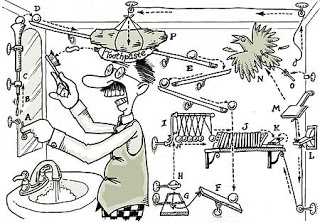
Rube Goldberg Machine

The "system" that we live in as a people here in America, how it works, who the system was designed by and who it was designed for, who controls it, what needs to be done about it, and why, are usual points of debate. And there are about 64655465861567 different answers to those questions for every person that cares to put their two cents in. So as an introduction to the Political Education and Conspiracy Theory series that are coming up here at BMD, I'll put my two cents in and point out some of the bullshit that people add to black political thought, by accident or on purpose.

1) Giving white people so much credit
    As a computer scientist by trade and an independent student of politics, history, and philosophy, all of these fields basically built themselves around the study of systems and critical thinking. The basic way a system works is it takes input, does something with that input, and puts out a result, based on how the system was designed. Whether that system works for you or not depends on what you put into it and how you use what it returns, the same with life in general. If you let some people who claim to be "pro-black" tell the story of "the System" they make the "white man" out to look like an unstoppable force driven to destroy the world, and we're waiting on that unstoppable (enter figure, event, or group of  people here) to wake up and stop it - like something out of a comic book. It may SOUND pro-black, but it really gives white people credit where no credit is due. Quit while you're ahead(or behind) because that way of thinking hasn't worked, and it's probably not going to. If a system exists, it can be studied, controlled, changed, or taken apart. Black power is about controlling any system that affects the lives of black people and making it work for us.

2) Black Nationalism and its role in the system
   When you hear the term "pro-black" the meaning changes depending on who it is that's speaking. If you study the movements of Black people in America, you'll find that "Pro-Black" is a pretty broad name for a number of different philosophies, like the Liberal/Moderate/Conservative polarities in mainstream politics. On one end you have Black Nationalism and Black separatism on the other. They all have similar goals, but different views on how those goals should be reached, and who can(and can't) put in the work to make it happen. Instead of recognizing how deep the movement really is, people get fanatic to the point that anyone who disagrees with them is "part of the problem''. Black Nationalism can be broken down into subsets focusing on culture, politics, economics, etc. There are groups that focus on these specific fields, and others that address all of these fields at the same time. At the end of the day, Black Nationalism advocates the advancement of Black People and pursuing those opportunities however and whenever they are available. Advancing in any of these fields, both on the individual, and collective levels, is a step in the right direction towards power and self-determination.

3) By (almost) any means necessary
   The above quote by Malcolm X is probably one of the most popular and mis-represented quotes of this century. The full quote, which many people like to leave out is ''We declare our right on this earth to be a man, to be a human being, to be respected as a human being, to be given the rights of a human being in this society, on this Earth, in this day, which we intend to bring into existence by any means necessary." Taken on face value, it literally means to do whatever is necessary to make sure that Black people overcome oppression to become self-sufficient and respected as a people. But going back to point #2, that list of "anything" eventually gets cut to a predefined set of options that look and sound “pro-black”.

   This series is designed to bridge those gaps that prevent us from making progress as a people, pointing out the advantages and disadvantages of the parts of the machine that we live in, and airing out the bullshit that ends up getting in our way.

Sunday, June 30, 2013

Post Racial America and Indirect Racism


  Since the end of the Civil Rights and Black Power movement, many white people have tried to distance themselves from being labeled a "racist". Although there are many other methods, the internet has long served as a safe medium for many people to voice their true feelings of other races in this current era called "Post-Racial America". With the beginning of George Zimmerman's murder trial, the judicial diarrhea of the US Supreme Court on the Voting Rights Act of 1964, and Paula Deen's (past) diarrhea of the mouth, the events of this week have removed multiple layers from the "Race Relations" onion of American society.

  There are 2 types of racism, both of which are common in the US, as defined by Kwame Ture (Stokely Carmichael) in his book Black Power : The Politics of Liberation(1967): Individual Racism and Institutional Racism.

  Individual racism is a small scale event between individuals or a small group of people in which one group acts against another based on an ideal that is intentionally or neglectfully racist. Paula Deen's "n-word" jokes are little more than examples of individual racism. Which, for those who didn't know, the law suit against Paula Deen was filed by a white employee, and it is about more than simple "n-word" jokes as described in this article from Black Legal Issues. Another example would be a group of Black guys beating up a white guy, just because he's white. As offensive as it may be, incidents involving individual racism do not have a lasting impact on the target group as a whole. But since it is on a person to person basis, the impact may last for the individuals involved. This factor is what allows racist ideals to be passed from generation to generation.

  Institutional racism is far reaching in the number of people it affects and is usually carried out by a group of people, although individuals can carry out this form of racism as well. This usually occurs when groups of people with racist ideals and states of mind get together - a majority of the time having positions of power. Where, as the picture above states, company policies, law enforcement practices, and legislative practices are created with the intention of harming, or infringing on the rights or progression of a designated group of people. These policies are designed and promoted as resolving a problem, but either intentionally or inherently create disparities through disenfranchisement, harassment, and other abuses of the negatively affected race. Some other race or group of races naturally benefits from it. The support for these forms of institutional racism comes from individual racists who would not want to openly express those views, or would otherwise be powerless to act on those views. Therefore they invest in or vote for, companies and politicians who will be able to deliver policies and business practices that have a similar ring to their racist ideals(although not explicitly stating so). The students of Prairie View A & M University's struggle for voting rights is a prime example of institutional racism, inspired by individual racists. Sporadic incidents of individual racism then begin to occur as a result of the policies and attitudes behind institutional racism.

  The Civil Rights and Black Power movements marked the end of the then commonplace overt racism. The passing of the Civil Rights and Voting Rights Acts, overt racism was outlawed. At that point, racial slurs took a back seat in the public eye, and made way for neutral terms like "criminals" and "illegals"(immigrants) to refer to a broad spectrum of people who will be affected by these policies. So we can ultimately define "Post-Racial America" as the period where it's OK to be racist(individually or institutionally) as long as you don't actually say that that is what you are doing. A period of time where race shouldn't matter, but it does, and unless there is a large enough group of people affected by it, there is no sure fire way to identify it.

  With a better understanding of what racism is and the different forms it can take, we can better prepare ourselves to develop and act on solutions to these problems. The problems of racism cannot be eliminated, but, similar to computer security, the threats or affect of those threats of institutional and individual racism can be transferred, delayed, or prevented from reaching fruition. By having a healthy and practical understanding of how racism works and the forms that it can take will help us to educate ourselves and others outside of the race in our continuing struggle is to secure economic, political, and social freedom and self-determination.

Peace

Saturday, June 22, 2013

The Black Silicon Valley

Ironically, I was listening to this song earlier in the day. Then heard Black In America was on.

I thought it was pretty good. As a people, we consume more technology than we produce. And with those working to create their own start-ups being in the NewMe Accelerator program, they already know what trying to break into the industry will be like. The telltale part of the show was when the Indian guy was telling them he had to use a white guy just to get his idea accepted into Silicon Valley. It shows us what the obstacles are and what level we'll have to be on to get known, for those of us in looking to get into the tech industry. But of course, the only way to recieve the best treatment and do business on our own terms is if we have our own cultur/economic centers, a Black Silicon Valley, similar to the Black Wallstreet we've had in the past.
I was in school for computer science... haven't finished the degree yet as I started working full time in anticipation of becoming a father. But I also saw that most of the people they featured on the show never graduated, and actually stopped at the same level that I did. Shows me, and hopefully others in my position that there's still more to struggle for than just getting a job. Takes self-education and motivation though. I've actually got quite a few ideas for software, games, and possible phone apps. Haven't been in school since the Spring semester of 2011, but I've still been trying to pick up where I left off and teach myself what I need to know about these programming languages to make them a reality.

A lot of times people in the conscious community get carried away with the "Matrix" talk and forget, or purposefully ignore, the fact that there are a lot of people who claim to be conscious but are out of touch with the average person that has to work a 9-5 or has dire financial problems that need to be solved.

 I'm not saying that independence shouldn't be or is not the main goal. But it takes money to start and run a nation, and money and skills to start a business. And you have to start small before you can move up to a city-wide, nation-wide or global clientele - all depends on what you're trying to do but the possibilities are endless. Build up clientele through your reputation and so on. I understand all that full well.

On an economically competitive level, we have to have some kind of training or skill development self-taught or otherwise. Nobody's going to do business with a doctor (holistic or not), a computer technician, carpenter, a teacher, etc.. with no training or certification. And if he/she fucks up while performing their job, they can't say "well there's nothing you can do cuz im not a citizen of the country(or a Sovereign Citizen) so the law doesn't apply to me" and not expect an ass whoopin(LOL).

I don't just sit on my ass waiting on someone to give me a hand out. I (1) use long ass facebook comments/conversations like these to write blog posts(http://blackmindsdev.blogspot.com/
), I recently started doing gigs on Fiverr.com, and since i'm not in school right now I've been teaching myself C++ and Python so I can actually create some of the software ideas I've come up with over the years.  There's money on the internet, and technology is and will be one of the many ways that black people will become competitive in the global economy, but unless you have a large following then you're just paying dues and scratching up money where you can. And I'm (2) looking for decent paying jobs that will a) help me develop my skills so i can run my own business, b) have a financial cushion for when I'm not getting much clientele, and c) have some start-up money (primitive capital) to be able to afford more books to further develop my skills and buy better equipment. Until then I've learned how to make do with freeware. Before I buy something I see if there is an equivalent free version. If there isn't then I try to get it cheap, or just do without. It's called survival and anybody with common sense would say that I'm not going to sit on the computer all day and not figure out how to use it to make money - applying for jobs or otherwise. There's more than one way to get up, get out, and get something.

(Updated 6/22/13) I have also attained the COMPtia A+ Certification, and I am currently studying to get the Network+ and Security+ certifications. The ultimate goal is to turn my knowledge and skills in computer repair and maintenance from a side hustle to an independent business. So once things pick up and when I get out my situation I can go back to the youth on the street in the same situation I came out of and say "I was in the same situation and this is one way to get out of it." But to do that you have to be in tune with the masses of the people, specifically the youth, because they're the main ones who need to be reached. They're the ones who make up the statistics that conscious people rant and rave over but preach to the choir (other conscious people) about, or teach the congregation (the masses) shit that goes over their heads or does nothing to solve their immediate, every-day, real life problems. If you're out of touch with those people, then no matter how you dress up your presentation they're either not going to listen, or they're going to give you more credit and power than you deserve which is no good for them. And that's the shit that I'm saying needs to stop.

Starting a nation and all that is good, like I've said before doing business and living under traditional African principles is a great goal. BUT focusing on starting a nation and developing our own laws and currency and all that is jumping the gun when the people you're supposed to be reaching can't or don't know how to pay their bills and fight dictators and corrupt politicians in the country they're living in now. And unless there are safeguards in place that the masses of the people know how to utilize, then those same masses that exist today on the bottom rung of society will exist in that future nation. They will be the worker ants of that new nation without a pot to piss in while they put money in the pockets of a new dictator with a black face. Denouncing your citizenship to where you don't have to pay taxes to America or any other European nation is all good and well but you have to have another nation to go to and a means of getting there or creating it (and PROTECTING it).

Monday, January 23, 2012

A Petition for Mumia


Mumia Abu-Jamal


When I was 6 and 7 years old, my mom used to listen to NPR while she was dropping me off at school. There would always be a segment of a man speaking. I didn't really understand what he was talking about, but one thing that stuck with me was the ending "From death row, this is Mumia Abu-Jamal". I've always researched Black history and when I got in my teens, I remembered that name. I looked it up, and read about the Panthers, and further into Mumia himself. I started listening to and reading his commentary on a regular basis 4 years ago. I also had the chance to look at some of his court transcripts and found that he initially had not been given adequate resources to defend himself. Abu-Jamal has been fighting for his life and freedom for decades. He recently won a battle to be taken off of Death Row. Since then, as opposed to being placed in the general population, Mumia has been placed in the Hole.

I think that Mumia's case and others like his should open up legislation as well as discussion about citizen's rights to defend themselves and others against police abuse (violent or not), under a clear cut set of circumstances. We know that some officers have in the past, and will in the future abuse their power and take advantage of any group they so decide to discriminate against. But their power to protect and serve does not mean that we should be placed as permanent victims of their brutality, railroading, abuse, as well as the condition of minority Political Prisoners, and the causes that lead one to become a political prisoner.

Support Mumia Abu-Jamal

Friday, November 11, 2011

Power and Discussion


Where do Black people fit into the Occupy Wall Street Movement? Although most would like to approach the OWS movement with a colorblind view, it's not realistic. There are problems that the Black community has that other ethnic groups don't have. Given that fact, the black community has to find some medium to discuss those problems and brainstorm viable solutions to them. This can't be done within the arena of OWS, or can it? Where there are similar problems we work to solve them with groups affected the same way. Where there are exclusive problems, we deal with them as an exclusive group.

Generally, when black politics are brought up in a racially heterogeneous setting most of those concerns and claims, no matter how legitimate, will be vehemently attacked. If we identify problems and their causes, people say we're complaining. If we identify solutions to our specific problems, people say we are being racist, divisive, exclusionary, and the like. Both types of responses are generally used to beat around the bush of the race issues in economics, politics, and society in general as opposed to dealing with the issue as it is. At least that is the experience that many blacks currently, or at one point, within the OWS movement have observed. The same goes for many who have attempted to present a black social or political platform to a mainstream audience in any setting throughout history. There's no doubt that there are plenty of blacks present at the Occupy protests in various cities. But are any problems native to the Black community being addressed? The short answer would be "No". The long answer is more complex.

The issues being addressed by the Occupy movement have a large impact on the economic and political well-being of the United States as a whole. The solutions that will eventually arise from the movement will undoubtedly have an impact on the Black community, as it will on all communities. But the question is what type of impact will it have? Given the possibilities, we should maintain a strong presence at the protests, general assemblies, and political actions when they are carried out. But to be effective, we must also work to address problems that are specific to our own community. For too long, we have allowed laws in the US to be made ABOUT us and not for us. There is a difference. A law made about black people can have a positive or negative affect. Regardless, it has some degree an intended affect on the black community.

The best way to do that would be outside of the OWS arena, in exchange for one that is more hospitable to the subjects of Black self-actualization and self-determination. But that discussion shouldn’t stay outside of the OWS arena. To ensure the success and widespread acceptance of the solutions to the problems that Black people face, I think it would be most effective to hold 3 different discussions: (1) a discussion on the solutions to our own economic and political problems, (2) A discussion on the solutions to problems of mainstream America that affect our community, (3) A discussion for how we can take advantage of the OWS movement whether our own resolutions pass or fail , and finally (4) A discussion that would involve tailoring our arguments and agenda in such a way that we don’t have to mention “black”, “African”, “African American”, or “minority” that can be presented and discussed in the arena of OWS. The results of the OWS general assemblies and the success of the new resolutions should be recorded and brought back to the independent table of the black community, and the process repeated until the movement ends.

In the end, we should have developed an understanding that these resolutions would benefit us without exclusively mentioning so. These would give our communities leverage by which we could secure enough power to become independent and self-determined as a people. This is how the ruling class has done it for centuries. They only made laws and rules specifically mentioning whites after they had secured enough power to limit intervention. If we expect to survive in the current political and economic climate, we’ll have to learn to adapt and take advantage of the same method. All in all, it would be foolish for us to completely neglect the OWS movement, but also equally ignorant to ignore using the momentum to fuel our own. The Occupy The Hood  movement seems to be heading in that direction.

Wednesday, October 19, 2011

They're ALL the Same


With the upcoming elections and criticism of the current political regime, we still have a lot of problems that have yet to be resolved. And people are mostly making a shift from a Democratic vote to a Republican vote. The thing that we should understand is that  both parties are really fighting for the same goal, they just have different views on how the country should get there. Unless you factor in credit, there has only been so much money to go around. The rich have most of it, the working class are struggling for the crumbs the rich drop.

 Democrats take money from the rich to give to the poor in the form of welfare, better working conditions, and a raise in wages. In return businesses raise their prices and claim that they had to do it in order to make a profit.

Republicans let the rich keep their money and hope they're nice enough give the poor jobs. Then the poor can't afford to pay the companies because they don't have much spending power, or end up losing their jobs to technology or outsourced jobs. Either way when it comes to foreign policy the goal is the same for both of them... keeping America and friends on top of the global political and economic weather.

 Regardless of which party's candidate is in power, the working class loses it's ability to keep its head above water, as a whole. Yes on an individual level people need to budget and save their money, etc. But if bills, and just trying to take care of your family, takes up most of your income, if not all of it, then what do you have left to save? Depending on your wage and what the economy looks like in your immediate area, that little "save $5 a day" rule eventually goes out the door for low income households because you didn't have the $5 to save in the first place. Up until the global warming and "alternative energy" issues came up, when politicians say they're creating jobs, they usually mean making it easier for corporations like McDonalds, Walmart, and temp agencies to put out more low paying jobs. A job is a job, but they might as well stop pretending to be helping us with jobs you can't even keep the lights on with.

When it comes to insurance, those companies have a lot of power that they really shouldn't have. They determine (directly or indirectly) a lot of the economic policies that the consumer, or the worker eventually pays for.

 The private sector has never kept the economy going. leaving everything up to the private sector is why you have the concept of the "99% vs the 1%." When an unofficial list of demands came out for the Occupy Wall Street game, most of the demands in the list revolved around closing corporate tax loopholes, decreasing the amount of political influence corporations have, and stopping congress from being able to give itself a raise. I don't know what they're doing now beside just randomly drawing attention to themselves. Most of the ruling class had a handout that put it ahead of everyone else in the game. The country's economic system is not about "how hard can you work to get ahead", it's about "who can you work hard to get where you want to be". Exploitation.

Tuesday, September 13, 2011

Hip Hop and Tupac Pt 1


Today marks the 15th anniversary of the death of Tupac Shakur. From the time I heard my first Tupac song, to the day I got my first album, to today – Tupac has played a “big brother” role throughout my life and I’m sure the lives of many others in my generation. When Pac died I was 7 years old. I didn’t have much exposure to rap at the time, but I had heard a few songs (California Love, 2 of Amerikas Most Wanted, and How Do You Want It) at different times that burned his name and sound into my mind.
I was in the 7th or 8th grade when I got “The Don Killuminati: The 7 Day Theory” (everybody called it “Mackavelli”). I had already built an interest in reading up on Black history, and eventually researching the artists that I listened to became a part of my self-education. I had heard the names of the Black Panther Party, Huey P. Newton, Malcolm X, and Black Power, but I didn’t know much about any of them in detail. Listening to Tupac’s more socially conscious music led me to study those names and more as a teen. Those studies and the messages in Tupac’s, as well as the lessons that can be learned from examining his life are what led me to my current understanding of Black Power. And without that world view this blog probably would never have been created.
Despite the events that took place in Tupac’s life that would raise eyebrows for many about Tupac as a man, and Hip Hop itself, few can argue against his artisic genius. From the feelings of sympathy, sadness, and desperation in songs like “Brenda’s Got a Baby” and “Lord Knows”, to the hyped, partying mood in “How Do U Want It”, to a pissed off but empowered feeling from “Letter 2 the President”, “White Man’s World”, “Panther Power”, and “Soulja’s Story”, to moments of introspection and hope with “Who Do U Believe In”, “Better Dayz”, and “Thug’s Mansion” – Tupac’s music is mood altering.
The brother’s lyricism and symbology have led to thousands of web sites, books, and YouTube videos analyzing his words. Fans looking to understand references he made to past and (at his time) present personalities, events, and concepts to drawing connections between opinions Pac stated when he was alive to things going on today. One thing I always try to remind people of when they get too caught up in the “illuminati killed Tupac” and “Pac being alive” hype is that it doesn’t really matter if Tupac is dad or alive. He put the messages in his music and tailored his persona and sound the way he did for a reason. From experience, I’ve seen that when you go too deep for too long on sociality or politically conscious issues, you can quickly lose the interest of groups ranging from preps to jocks, to thugs and wanabe’s. Tupac tailored his music so that the conscious message was still present in most of his songs, but it didn’t turn off the average listener who wasn’t interested in such subjects.
Whether you understood or agreed with his message or no, you still heard the message; the seed was still planted. Whether those seeds take root through conversation, experience, or your own study is up to you and chance. Regardless, Pac put the messages in his music not for us t argue whether he was dead or not. He wanted us to feel the way he felt about the issues he spoke about and act on those feelings. Tupac said “I may not change the world, but I guarantee you I will spark the mind that is going to change the world.” I would like to think that I am one of those minds. R.I.P. and Thank You, Tupac.


Thursday, August 11, 2011

The Science of Police Abuse Part 1


A billboard along Hwy 290 in Texas. You already know what that flag really represents...
  

In light of the recent police shootings in San Francisco and London, I though I'd do a post on my most recent run in with the laws(police). For those who don't know what's going on: in late July, San Francisco police shot a 19 year old (Kenneth Harding, Jr.) who tried to run from them after he was confronted about not having a bus ticket. There are viral videos all over youtube with the aftermath. In London, members of the working class have been rioting all week due to the shooting of an unarmed man (Mark Duggan) while working. Bored police are a dangerous police, and they are trained to be suspicious and intimidating, they're naturally paranoid, and have the benefit of the doubt when it comes to the law.

   Yesterday a coworker and I were driving home from work. We were on the road around 2am, since we work the night shift. A car that was in front of us suddenly pulled over at a crossover on the highway. The car didn't turn, it just waited for us to pass it. It turned out to be a Texas State Trooper. He pulled out and started following us. He would pull up close behind me, then give me a little room. When I changed lanes, he pulled into my "blind spot" and then backed up. Then he pulled up next to us (looking in the car) then backed into my blind spot again. I'd seen it before, usually with officers working at night. I knew better than to drive straight home, so I drove to the closest gas station (5 miles down the road) where I knew there would be lights, cameras, and witnesses to whatever it was he ws planning to do. He followed us the whole way, driving in my blind spot.

   When we pulled into the parking lot, the officer stood in front of our car waiting for us to get out. He asked where we were coming from, and we said we had just got off work. He asked where we worked; I told him and asked if I needed to call my supervisor. He said no and asked where we were headed; I said "in the store". So the officer opens the door for me and follows me around the store. When I go to check out, the officer goes back outside, gets his flashlight out and starts looking in my car. My coworker went outside to ask him what he was doing. After I finished checking out, I asked the cashier for some paper and a pen. I got the officer's name, badge number, and his license plate number. I'll file a written complaint soon.

   I started off with the story, now let's look at what was going on between the lines. The officer had no valid reason to pull me over, which is why all he could do was follow me then wait until I stopped to ask questions. The way the officer was driving when he first started following us was his way of making his presence known. he wanted to see if he could provoke me to act suspiciously (ie. ducking onto a backroad off the highway, speeding off to evade him, or throwing shit out the window) to give him an excuse to stop us. I acted like I wasn't paying him any attention and kept the same speed.

  When we got to the store, the officers initial approach was legal. He asked questions and I answered. Usually, I won't answer any of an officer's questions. I say "I'm going to remain silent" from the jump, even to the most trivial questions. Legally it puts me at a slight advantage, but out there on the street it can usually make things worse. I've learned from experience that you have to be able to tell when it's best to answer the (trivial) questions and when not to answer any questions at all. I/you should never answer any of an officer's questions or statements that imply criminal activity or probe for signs of guilt (It doesn't matter if you're doing something wrong or not). Now, once the officer let me go into the store, legally, that should have been the end of the encounter. Since I wasn't being detained I could've gone straight into the store from the start, but again, you have to pick the best strategy dealing with bored police officers. In the store, the officer pretended to shop, but always moved to keep me in full view. Stalling, I walked around picking up items, putting them back to get others, and getting stuff I knew I couldn't afford. When I got to the register, I had about 3 or 4 items. I used my bank card to pay first (which I knew didn't have any money on it), then paid for only 1 of the 4 items with change and left the rest.  After my coworker went to see what the officer was doing he said the officer was checking the door handles (to see if they were unlocked). After I got his information my coworker and I went back into the store to talk with the cashier and another local resident until the officer left before heading home. This was clearly racial profiling and harassment, but the situation played out a lot better than what could have been. I could be in the hospital, in jail, or dead.

   The officer crossed the line when he started looking in my car while I was at the register, especially trying to open the doors without my consent. Once he let me enter the store, that should've been the end of the altercation (I was free to go), but he decided to see if there was anything he could find as an excuse to harass us some more, and hopefully make an arrest. Though the police are sworn to protect and serve the citizens of the country, their functional purpose to date has been to serve and protect the interests of the ruling class. Other than that, many of them serve and protect not a goddamn thing. Of course there are plenty of individual exclusions to that statement, the general, practical, function of law enforcement on all levels says otherwise. I've got plenty of stories like this and I tell them to people all the time because there are a lot of people (especially foreigners and upper class, or conservative blacks) who just don't believe or are naive to the nature of police, the affect they have on our communities, or the fact that these conditions can be changed if more people get involved with finding solutions to issues of police abuse.

Part 2 coming soon.

Tuesday, July 19, 2011

The Ballot

Today I wanted to talk a little about voting and how we as a people can use it to our advantage. Whenever election time rolls around (for anything) we all hear the average person on the street, and people in the "conscious" community say "I don't vote because voting doesn't work" or xyz excuse. Really, if you understand how the system we're living in works, it becomes a self-fulfilling prophecy. We as a people get screwed over between elections (and every other day), so we don't vote. Since we don't vote, the people who DO vote are the ones who either make the decisions, or choose the people who will make the decisions. And 9 times out of 10 they aren't going to work with our best interests in mind. So, we get screwed over and voting doesn't work (for us)... because we didn't vote. Nothing happens TO us. Only what we did or didn't prepare for.

There are different ways to vote, different issues to vote on, and different areas of life where voting and elections are a part of the decision making process. The 2 that I focus on here are government and business. In government, we vote for the candidate we believe will represent our best interests. That's the idea we're told at least. The candidates may not live up to the "word is bond" principle by doing everything (or anything) that they said they would do, but that doesn't mean we shouldn't vote.  Don't like Democrats or Republicans? On all levels of government (local, state, national), there are many other parties besides the Democratic and Republican parties. There isn't much difference between the 2 parties anyway, they just have different ideas on how the same goal should be achieved - overextending America's influence... aka dominance. The other parties usually don't get as much airtime in the media because people don't look into them, or look for them, like they should. Other organizations and parties have other methods of resolving political issues. Some with candidates who may be more open to listening to our demands and working with us to make them happen.

As a people our past experiences with voting have been bitter sweet. From poll taxes to reading tests and threats, to "zoning", registration, and ballot issues we have had to struggle for our right to vote from day 1.

But, whose fault is it when their elected official's fail their word? It's ours. Because they are elected officials, they are suppose to represent us in the government. Politicians work for 2 things, money and votes. If you're not giving them contributions to their next campaign, sponsoring a program that they came up with, or voting for them, then your opinion doesn't really matter. Part of "civic participation" involves keeping your elected officials in check. Attending meetings, contacting them, telling them about the problems you have in your neighborhood or community (and possible solutions), fighting for minority businesses to be contracted by the government on all levels - all of those fights are fights that voting citizens have the influence to fight. If you put a politician in the position where he has a choice between being reelected and a pissed off voting bloc, he will work to solve their problems. Elected officials are supposed to, or claim, that they serve us, so it's up to us to make sure they do that.

The next method of using the ballot to our advantage is in the business world. When you buy stocks, you become a partial owner of that company. Many businesses allow for stock holders to vote on certain decisions the company will make. The issues shareholders can vote on depends on the company, but some of those issues include selecting the executive board/board of directors, deciding on company policies such as whether to develop reports disclosing their spending habits and political support. Just as in the political world, the more people you have voting together for the same cause, the more power and influence that group will have. Buy stocks, and vote.

Stop making excuses to not get involved and stay on top of what the people who influence your life are doing. If you leave someone else to make life-changing decisions for you without checking them, then you can't say anything when they reap the benefits of your work, too. Government and business are supposed to be here to serve us, not give us toys and dreams to chase while they take off with the spoils of our wok in the process.

Thursday, May 26, 2011

A Discourse on Black Power


The other day I had a conversation with a friend of mine from high school (who happens to be Hispanic). I had told him about the blog and we had a discussion about the purpose and content. He wished me luck, but was concerned about the blog being specifically made for Black people, saying that it seemed exclusionary or separatist.  I compiled my responses to his questions and comments into one post.


Being Black, and seeing the condition we're in, I feel an obligation to work on improving our condition. I was nurtured into thinking this way, and naturally drawn into it. My mother taught me about the danger I was in as a Black man in this country, as well as how to read and learn about my history. I took that and ran with it (since the age of 7). I study and appreciate all cultures worldwide, but I make it a point to study my own. No one says anything when Asians release a video game or movie strictly about Asian history and culture, or when whites release a TV show with only white actors, or if they release a video game with all white characters. They are dealing with subjects related to their culture.


BMD is the same thing.


Although the bigger issue is class, each minority group has its own problems that are unique to that group with respect to its history in this country, or wherever they may be. No one is more qualified to talk about your problems and how they affect you than you are. Stokely Charmichael speaks on this in his book Black Power : The Politics of Liberation. You can't have a partnership with anyone else until you are secure and independent yourself. On an individual level, a person who can't help themselves can't help anyone else either. They have to have some level of independence. Otherwise, that partnership would become either parasitic on the individual's part, or predatory on their partner's part. If both parties are independent, prey/predator and parasitic relationships are less likely. And the same applies to any type of relationship. It is the same on a group level. Black people can't work with other races until they are able to function on their own. So yes, working with other races is, or will become, necessary because the real problems are social and economic class conflict (which goes above race and gender). But we can't have successful partnerships or ally relations until we get own out sh*t together.


Another example (in wake of the immigration issue): I work with Asian and Hispanic immigrants. Many of them speak their own language when talking to each other. The Hispanic guys also play the Latin station on the radio from time to time. They are doing what they're supposed to do, holding on to their original culture. Would it be right for me to tell them (when it is not work related) "Hey, you guys need to speak in English because I can't understand what you're saying" or "You guys need to change the station because I can't understand what the people on the radio are saying." Or "I just don't like Latin music." I can either A) Be parasitic and constantly ask them what is being said, B) Listen to the station without knowing what's being said, and appreciate the music for how I am able to see it. C) Listen to the music, not understanding it, and wishing someone would change the station, D) Be predatory and force them to change the station, or E) Learn Spanish so that I could understand what's being said both in their conversation, and on the radio.


Black Power, in it's original sense, doesn't mean having power OVER anyone else. It's about being in control of yourself and your environment. If you look at the content of the blogs, the things that I'm talking about are something everybody should know; the stuff that isn't culture specific. I'm discussing different avenues that we can us to get economic, political, and social power. Even then the content that is culture specific isn't or shouldn't be offensive.  If it is, you can't please everybody. You can either learn about it so you can understand in the future, or leave it alone.

Thursday, May 19, 2011

Watching the Watchmen: Your Rights and the Police (Part 2)


The link above is to an article describing an altercation in which a Black teenage girl recorded a police encounter while riding the bus (public transit). The officers took her phone, deleted the video, and detained her (kept her in the squad car, cuffed) for a while, then let her go.

I was in a similar situation this article a couple years ago ('09). My roommates had called me outside because one of our housemates (Jay) was being arrested suspected of drunk driving and evading the police. The police had said that they followed him from campus all the way back to our house. At the time he was going through some things, and was in a rut of depression and suffering from all the things that depression can bring.

I came outside with a pencil and paper, asking the officers for their information. The lady cop was cool, she just asked me to step back until they were done. I stepped from the edge of the carport, back to the front door (to give them distance). One of the other officers kept asking Jay direct questions like had he been drinking and why didn't he stop, etc. I kept yelling out to him that all he had to give them was his name and address, and to remain silent after that. Jay was wasted so he kept talking, but I kept yelling out the same thing. 

The officer that was asking the questions got mad and approached me telling me to go back in the house. He said I was interfering with his investigation. I told him that I was standing a safe distance away, that I had a right to be where I was, and a right to observe and record what they were doing. He said if I didn't go back in the house I'd be getting in the back of the squad car with my homeboy. I wouldn't move so he started counting, and one of my other housemates finally told me to just go inside. 

We all went back in the house(and locked the door). I opened the window to the front room, and kept writing everything down and saying the same stuff I had been yelling outside, LOL. Finally the officer told Jay that he "should listen to your homeboy because he's probably a criminal justice major", and then he looked at me and said "but we're trained professionals so we know more about what we're doing than you". I just said "OK" and wrote all that down. They arrested him, and I recorded everything that the housemates had taken out of his car before the officers had the car towed away. Afterwards, I went back outside to meet with the lady cop who came back and gave me the names and badge numbers of the other officers who were present. The one that had told me to go back in the house was quick to get back in his car.
First thing in the morning I called one of my mentors who is a law professor and asked him the procedure for filing a formal police complaint. I explained the situation to him, and he told me to type everything up and that he would make a few calls (he is well known around the school and town). "Jay" got out of jail the same day, didn't have to pay bail, got his car back, and all charges against him had been dropped. That part had more to do with the pull that the mentor had with officials around town, but if I hadn't reacted the way I did my homeboy would most likely be rotting in TDC (Texas Department of "Corrections") right now.

Expanding on the ideas covered in Part 1, these are examples of what can happen when you assert your rights, and how the police may react due to the fact that most of them don't really know how to react. Most of them are not used to their activities being observed or dealing with a citizen that knows his/her rights and asserts them properly. Whether your situation ends up like the sister's in the article, or like the one I just described, if we don't actively observe the police and assert our rights, we will continue to be victimized. Learn your rights, study the law, and prepare for whatever the response will be whenever you are tested.